
Covering a Hair Transplant Scar with SMP: What's Actually Possible
A strip scar or a dotted FUE donor area can keep you from wearing your hair short. SMP can make that scar far harder to see. Here is how it works, who is a good candidate, and the honest limits of what pigment can do on scar tissue.
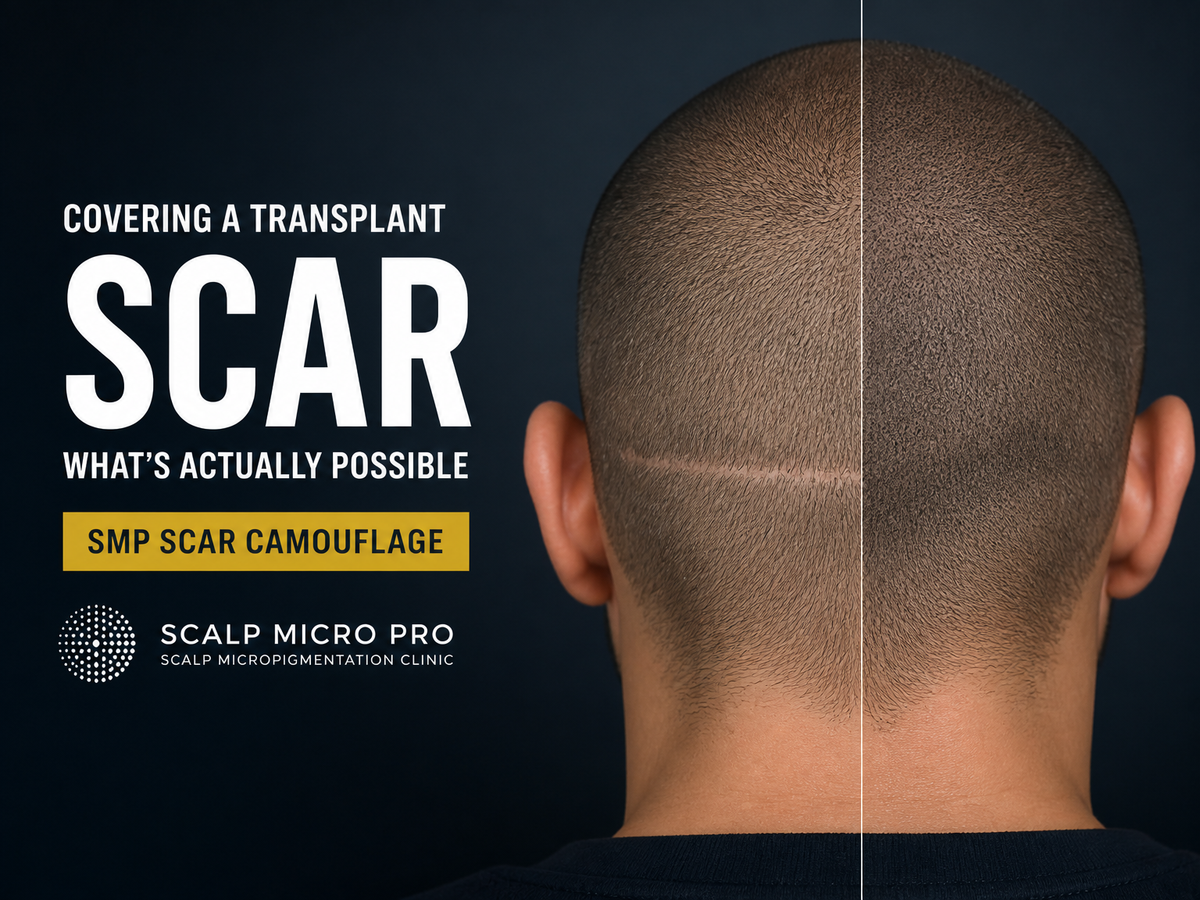
A lot of people who come to us for scar work had a hair transplant that did what it promised on top. The problem is at the back: a thin pale line from a strip procedure, or a scattering of small white dots from FUE, that shows up the moment the clippers go below a certain guard. So they stop cutting their hair short, and the transplant that was supposed to give them options ends up taking one away.
SMP is one of the most reliable ways to fix that. Not perfectly, and not for every scar — but for most donor-area scars, it is the difference between noticing it from across the room and needing to look for it.
Why scars show through short hair
Scar tissue has no follicles and very little pigment. Against a scalp covered in the small dark dots of short hair, it reads as a pale gap. The shorter the hair, the stronger the contrast.
That contrast is what SMP targets. By placing pigment impressions into and around the scar that match the surrounding stubble, the pale area stops reading as empty.
FUT strip scars
A strip procedure leaves a linear scar across the back of the head, usually from ear to ear. Width varies a lot from person to person — some are a fine line, some have stretched over the years.
The approach is to pigment into the scar and just beyond its edges, then feather the density out into the surrounding scalp so there is no visible border. A wider scar needs more work, and often one more session, than a thin one.
FUE donor scarring
FUE removes follicles one at a time, which leaves many small round white dots across the donor area instead of one line. When the donor area was heavily harvested, those dots can merge into a see-through, moth-eaten look.
Here SMP works by blending pigment across the whole donor zone, filling the pale dots and restoring even density so the area matches the rest of the head.
- FUT strip: pigment into the line, feathered out
- FUE dots: density blended across the donor zone
- Injury and surgical scars: assessed case by case
- Usually 2–3 sessions, sometimes one more
Who is a good candidate
The best results come from scars that are:
- Mature — flat, pale and no longer pink or tender.
- Stable — not changing, stretching or still healing.
- Flat or close to flat with the surrounding skin.
Timing matters. Scar tissue keeps remodeling for months after surgery. Most practitioners want to wait at least six months after the procedure, and often closer to a year, before working on it. If your scar is still pink, it is still changing.
What to expect from treatment
Scar tissue does not behave like normal scalp. It can absorb pigment unevenly, it can hold slightly lighter, and it can take a session to learn how your specific scar responds.
Expect the first session to reduce the contrast significantly but not finish the job. The next session builds on what the scar held, and the pattern repeats until the area blends. Healing and aftercare are the same as any SMP session.
Scar work combined with density on top
Many people who need scar camouflage also want more density up top, particularly behind transplanted hair where the graft count could not recreate their original thickness. Both can be planned as one treatment, so the donor area and the top of the head match in tone and density instead of being handled as two separate jobs.
Final thoughts
If a transplant scar is the reason you keep your hair longer than you want to, it is worth an honest look. For a mature, flat scar, SMP can give you back the short cut. For a raised or still-changing scar, the right answer might be to wait, or to treat it differently first — and a good practitioner will tell you that before taking a deposit.
Bring your surgery date to the consultation and, if you have them, photos from right after the procedure. They help us judge how the scar has matured.
Frequently asked questions
Ready to see if SMP is right for you?
Free consultation · No pressure · Straight answers from a specialist.
New guides, straight to your inbox
Occasional, no-spam emails with new SMP guides, before & afters and the odd consult opening. Unsubscribe anytime.