
The Norwood Scale Explained: Where You Are and What SMP Can Do
The Norwood scale is the chart doctors and SMP artists use to describe male hair loss, from a slightly receding hairline to a fully bald top. Here is how to find your stage, what each one means, and what SMP typically looks like at every point on the scale.
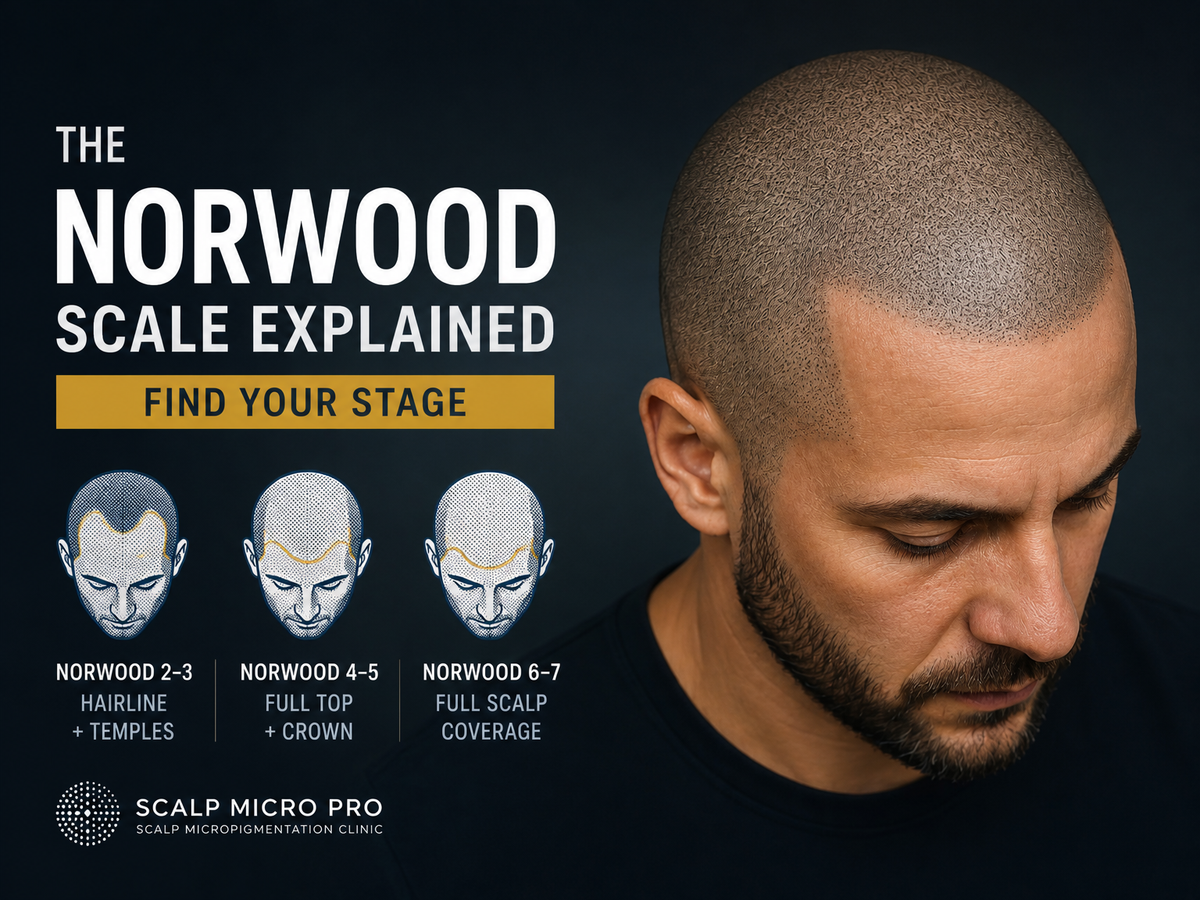
If you have researched hair loss for more than ten minutes, you have seen the chart: a row of heads, each one balder than the last. That is the Hamilton-Norwood scale, usually just called the Norwood scale, and it is the shared language between you, a doctor, a transplant surgeon and an SMP artist.
It is worth understanding, because it answers the first question most people have about SMP: what would it actually look like on me?
What the Norwood scale is
The scale was first described by Dr. James Hamilton in the 1950s and refined by Dr. O'Tar Norwood in the 1970s. It classifies male pattern hair loss into seven stages based on two things: how far the hairline has receded, and how much the crown has thinned.
Norwood 1: no significant loss
A full adult hairline with no meaningful recession. SMP is rarely needed at this stage, though some people use it for scars or to add a little shadow behind already-thick hair.
Norwood 2: the mature hairline
A slight recession at the temples, usually forming a subtle M-shape. This is often a normal maturing hairline rather than active hair loss.
What SMP does here: very little, or subtle temple softening. The honest advice at Norwood 2 is often to wait and watch.
Norwood 3: visible recession
The first stage generally considered hair loss. The temples recede into a clear M, V or U shape. A variant, Norwood 3 Vertex, adds thinning at the crown while the hairline stays around stage 2 or 3.
What SMP does here: rebuilds the temples and firms up the hairline. If you keep your hair short, SMP also adds density behind the front line so the transition looks natural.
Norwood 4: hairline and crown both thinning
Recession at the front is deeper and the crown has a clearly visible thin spot. A band of fuller hair still separates the two areas.
What SMP does here: hairline restoration plus crown coverage, usually with a shaved or very short style so the pigment and your natural hair match.
Norwood 5: the band thins out
The front and crown areas get larger, and the band of hair between them thins and narrows.
What SMP does here: full top coverage. This is where most people commit to the buzzed look, and SMP makes the whole top of the head consistent with the sides.
Norwood 6: the band is gone
The front and crown have joined into one large bald area across the top. Hair remains on the sides and back.
What SMP does here: a full scalp restoration, with a new hairline designed from scratch and density blended seamlessly into the existing hair on the sides and back.
Norwood 7: the most advanced stage
Only a narrow horseshoe of hair remains around the sides and back, often thinner and lower on the neck than it used to be.
What SMP does here: complete coverage, often including the sides and back so the entire head reads as one even shave. This is also where transplants are most limited, because there is little donor hair left to move.
- Norwood 2–3 → hairline and temples
- Norwood 4–5 → full top and crown
- Norwood 6–7 → full scalp restore
- More coverage usually means more sessions
Plan for the next stage, not this one
Hair loss is progressive for most men. If you are Norwood 3 at 30, it is realistic to assume you will be further along at 40.
That is why a good SMP hairline is not the hairline you had at 19. It sits at a height that suits your face now and still looks natural as the hair behind it thins. If loss progresses, SMP can be extended to cover the new area without redesigning what is already there.
Where women fit
The Norwood scale is built for male pattern hair loss. Women usually thin differently — a widening part and diffuse thinning across the top while the hairline stays in place — which is described with the Ludwig scale instead. SMP for women focuses on density under existing hair rather than a shaved look.
Final thoughts
Knowing your Norwood stage takes a lot of guesswork out of the SMP conversation. It gives you a realistic idea of scope, sessions and cost before you walk in, and it lets you look at before-and-after photos of people who started exactly where you are.
If you are not sure which stage you are, that is fine. We will tell you at the consultation, and show you results from clients at the same stage.
Frequently asked questions
Ready to see if SMP is right for you?
Free consultation · No pressure · Straight answers from a specialist.
More from the journal
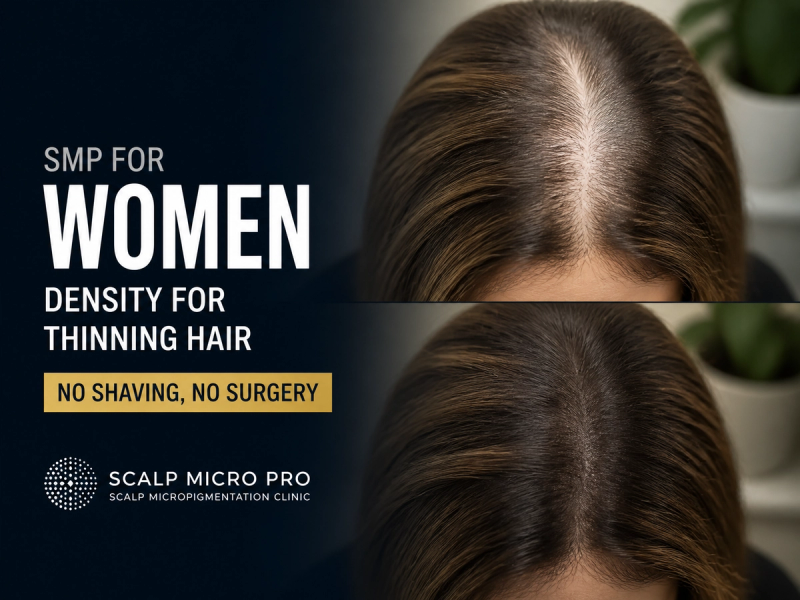
SMP for Women: Adding Density to Thinning Hair and Widening Parts
Scalp micropigmentation is not just a shaved-head treatment. For women with thinning hair, a widening part or a see-through crown, SMP adds density underneath the hair you already have — no shaving, no surgery. Here is how it works and who it suits.
Read more · 5 min
What Is Scalp Micropigmentation? The Complete Beginner's Guide (2026)
Scalp Micropigmentation (SMP) is a non-surgical hair loss solution that creates the appearance of fuller hair using specialized pigments. Learn how it works, who it's for, how long it lasts, and what results you can expect.
Read more · 8 minNew guides, straight to your inbox
Occasional, no-spam emails with new SMP guides, before & afters and the odd consult opening. Unsubscribe anytime.